When first learning integration rules in calculus, we start with the power rule. The differentiation and integration of power functions is very simple and can be automated in computation software.

The integration formula follows directly from the rule for the derivative. If we differentiate the second formula, we get the integrand.
You might have learned a couple ways for proving this formula. One is to directly apply the definition of the derivative, making use of the binomial formula and the limit techniques. An easier way, for integral powers excluding -1, is to simply use induction on n. We know that the derivative of x is 1 from the definition.

Now, we assume that for some positive integer n greater than or equal to 1,
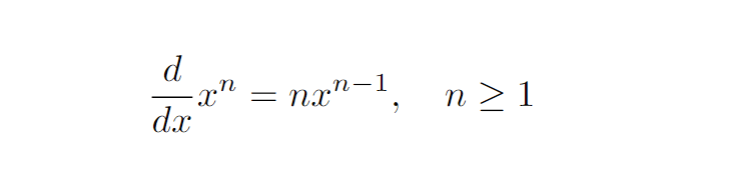
and show that the formula holds for n+1. For this, we use the product rule.
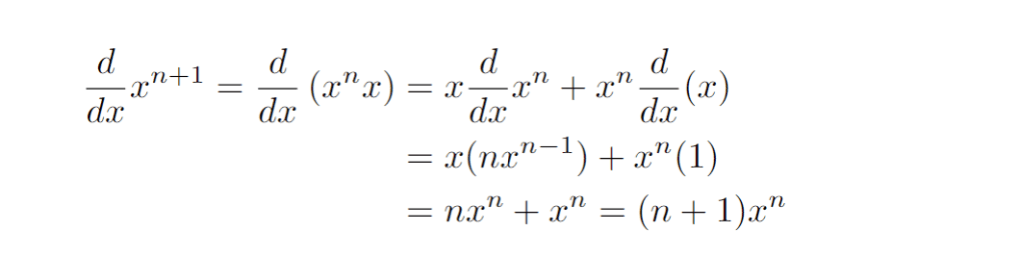
Now, for negative integral powers (excluding -1), we just use the formula with the quotient rule.
Of course, polynomials become a straight-forward matter, since the derivative and integral are linear — we can distribute the operators through a linear combination of the monomials of degrees less than or equal to n, for a polynomial of degree n.
Now comes the main point of this post. We want to understand the case for -1. As is customary in mathematics, when we don’t know what a function is, we “invent” the function using an integral definition. Let the integral of 1/x be denoted by L(x).

It should be clear as to why c > 0. We cannot integrate over the singularity at 0 (the integral would become infinite). We can say several things about this function right away. First of all, the function is zero when c = 1 and x = 1. Secondly, the integral is positive for x > c, and negative for x < c. Now, suppose a and b are both positive numbers. Then, using fundamental integration properties (u-substitution, which is essentially the chain rule in reverse) and linearity, and choosing c = 1 we find that:
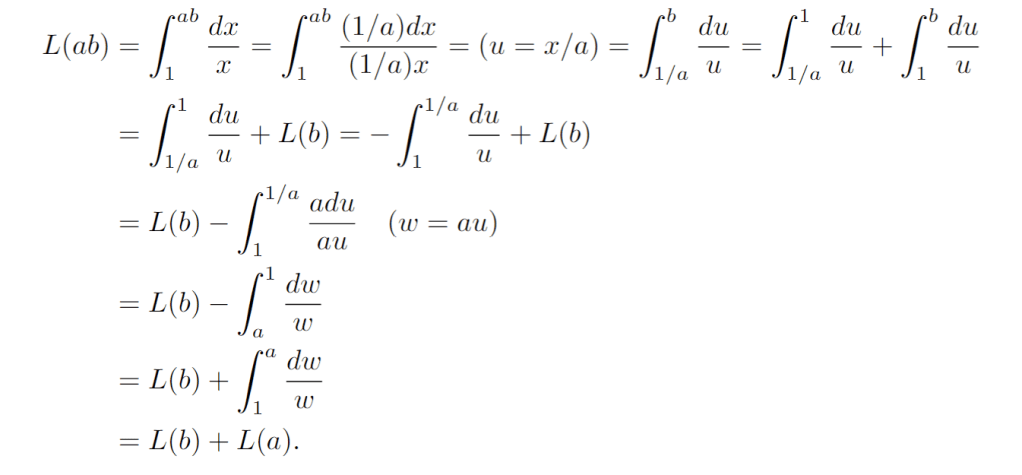
Now, because L(1) = 0, we can also show a formula for a/b.
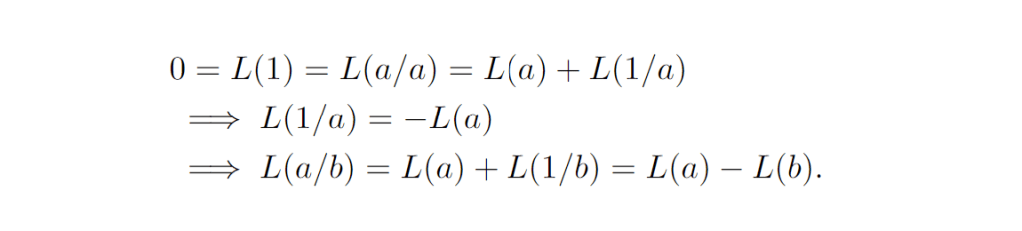
Is is now clear that this function, which is continuous and satisfies the above properties, must be the natural logarithm!
This, in my opinion, would be a great exercise for calc 1 students. Deriving the rules of the natural log from the integral definition.
If you enjoyed reading this post, please leave me a comment :).
 Math Techniques & Exploration
Leave a comment