In this post, I will discuss an interesting integration technique not commonly taught in school. We will review integration by parts first, and then discuss a technique called complexification of the integral. Both methods are useful for integrating trigonometric functions. For today’s application, I will show how complexification can uncover interesting properties of integrals used in Fourier analysis.
A common integral for first learning integration by parts is one involving an exponential – cosine product. Because the cosine function repeats itself after two derivatives (or integrations), we need to apply integration by parts twice to solve the problem. Here is the process.
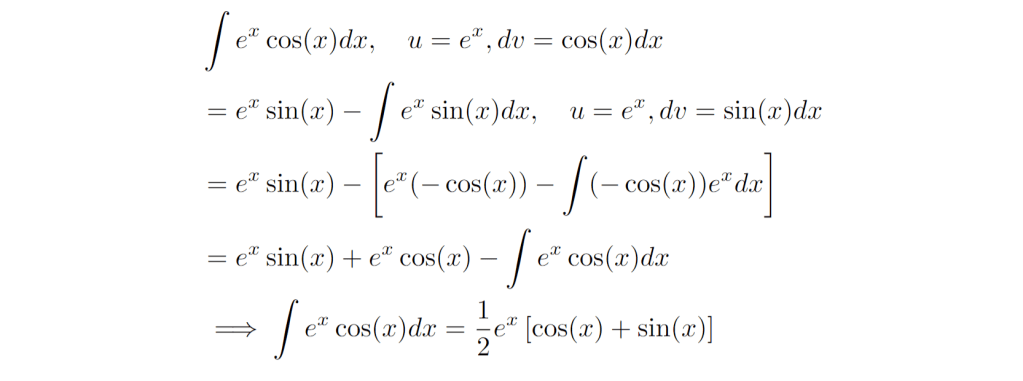
Students will typically find this example challenging because they want the integration by parts to directly lead to the solution. But here, due to the periodicity of cosine, we can only find a result involving the original integral. We thus need to solve the equation by moving the integral of interest to one side.
You might be wondering if there is a direct way to compute an integral like this — an there is! Enter complexification.
The idea is to express trig functions in terms of the complex exponential, which is credited to Euler and known as Euler’s formula.

By introducing (-x), and knowing that cosine is an even function, and sine an odd function, we can derive formulas for sine and cosine.


We can substitute these formulas in for sine and cosine, and then apply the integration rule for the exponential function. For our problem above, which involves only cosine, it is arguably easier to just take the real part of the integral. Real and imaginary parts may be denoted as follows.

Now, the above problem may be solved as follows.
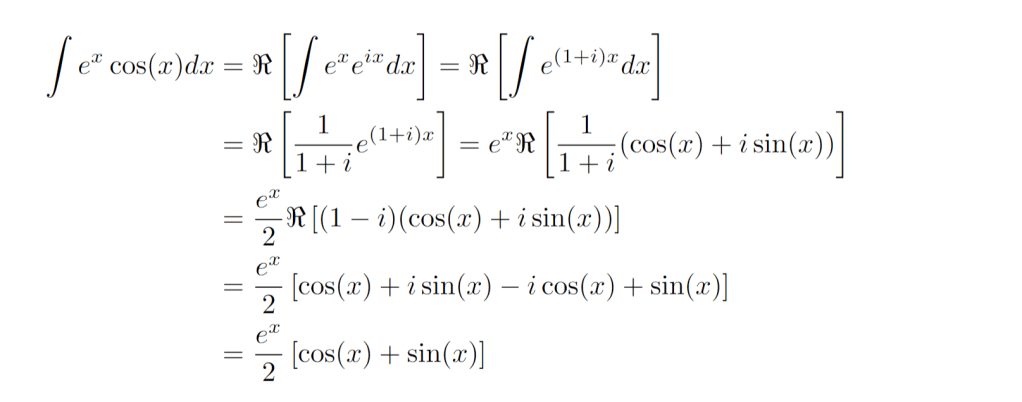
Of course, we find the same result as with integration by parts. For e^x sin(x), you would follow the same process, but instead taking the imaginary part.
Now, in computing Fourier series for functions, there are various useful formulas involving products of sines and cosines with different frequencies, which might be introduced in a course on partial differential equations. A great webpage for these formulas is on Paul’s Math Notes.
Because sine and cosine are odd and even, respectively, it should be clear that integrating any product of these functions over a full period will yield zero as the result. What is not so obvious (at least to me) is why the integrals of products of two cosine functions or two sine function with different frequencies over a full period are also zero. The specific result I will show in the remainder of this post is

Here, m and n are integers. For simplicity, I will take L = 1. The following calculation is somewhat tedious, but every mathematician should see it at least once 😉
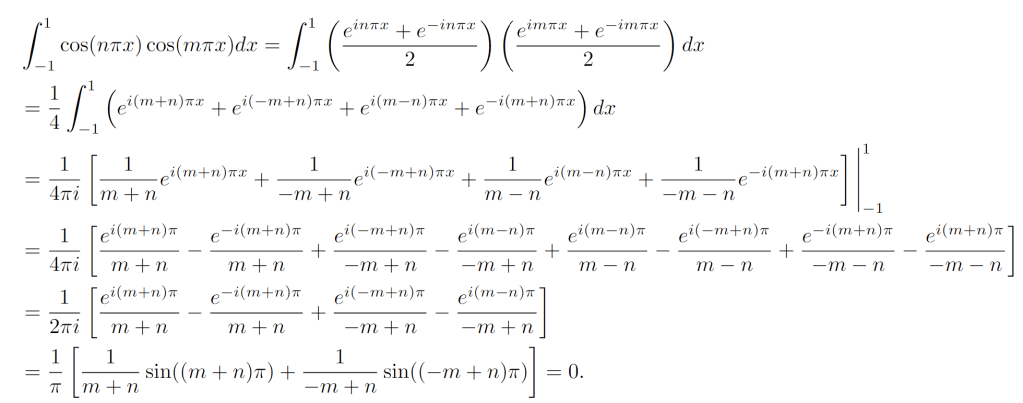
As an exercise, you can practice this calculation with the product of sines with m not equal to n. This integral will also be zero.
I hope you enjoyed this post and found it helpful. If so, please give me a like, and comment if you have a particular topic you are interested in. I also welcome other math bloggers, if you want me to check out your website.
 Math Techniques & Exploration
Leave a comment