Hello! And welcome to today’s post! I’m going to discuss a bit on functional equations, and several methods for solving them. At the end, I list a few great textbooks if you want to learn more.
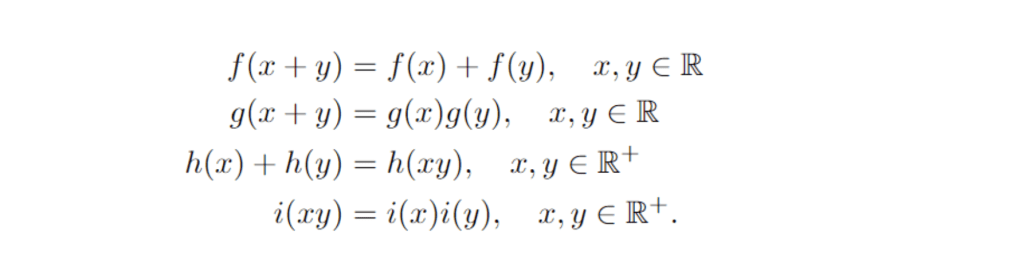
A functional equation is a relation involving a function and different variable arguments. Functional equations may involve no explicit variable expression, or they may contain an explicit expression of the independent variable(s). Cauchy’s equations furnish classic examples of the first case:
An example with some explicit variable expression is

The study of functional equations is a vast field, which is particularly difficult because there is not a very straightforward theory for solutions. In contrast to the study of linear algebraic, difference, or differential equations, there is not a universal theory as to how many independent solutions we can expect from a nonlinear equation. Furthermore, a functional equation not involving derivatives imposes no requirement for smoothness of solutions. So, in principle there may be various non-smooth solutions.
For this post, I will simply illustrate how some functional equations can be solved by converting them to differential equations. This approach enables us to find smooth solutions to some equations. This is the first method I want to discuss, which will be employed on the first two of Cauchy’s equations.
As with any equation, the idea of “solving it” amounts to eliminating the non-trivial dependencies. In the case of differential equations, these are dependencies are derivatives. For functional equations, these are dependencies on complex arguments of independent variables. A functional equation is solved when we are able to extract a relationship with the argument “x” alone, and no nonlinear expressions involving f(x).
Let’s start with Cauchy’s first equation. The idea is to take partial derivatives as needed, in order to form a system of equations in which the terms involving non-trivial arguments can be eliminated.
Taking the partial derivative of the first equation with respect to x, and then with respect to y yields:

Subtracting the two equations tells us that

Because we have a function of x identically equal to a function of y, the two must equal a constant.
So, the solutions are simply the linear functions.
Let us continue with the second equation. Differentiating first wrt x, then wrt y, we find that
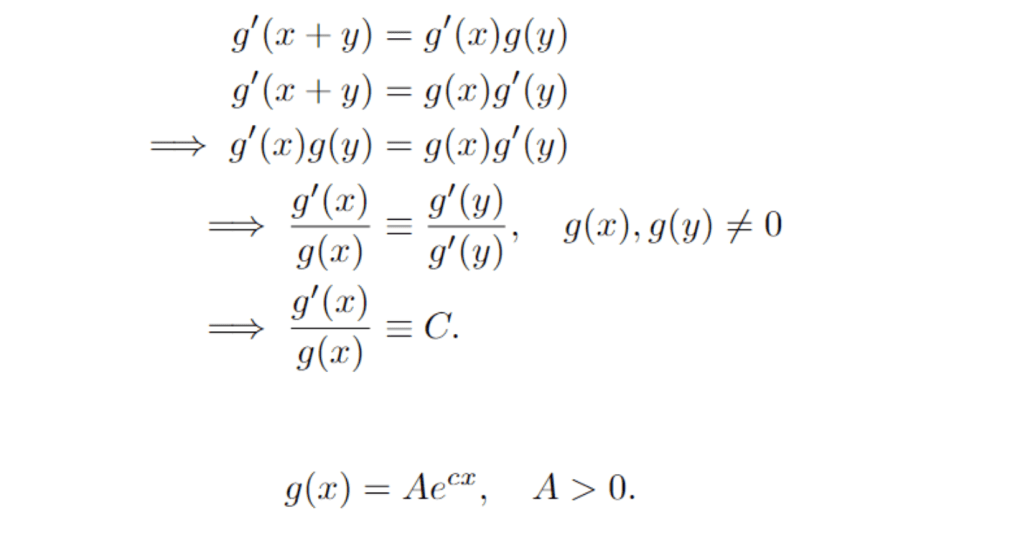
So, the solutions are exponential functions!
I will leave you as the reader to solve the third and fourth equations.
Here is a more complicated example, where the derivatives are not as easy. This is d’Alembert’s equation.

Taking the second partial derivative wrt x gives us
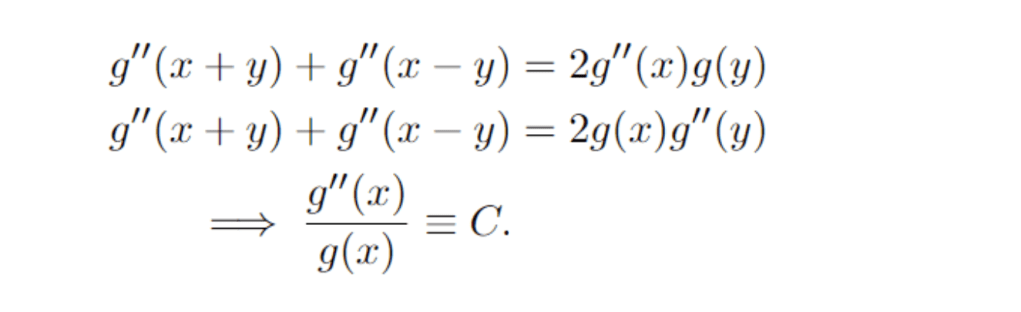
As you may recall from a class in differential equations, this equation has very different solutions depending on the value of C. If C<0, we get sinusoidal solutions, and if C>0, we get exponential solutions. Finally, if C = 0, the solutions are linear functions.
Because we want the solution to vanish at infinity, zero is the only valid solution.
As an exercise, try to solve the equation below, finding all valid f,g such that









 Math Techniques & Exploration